
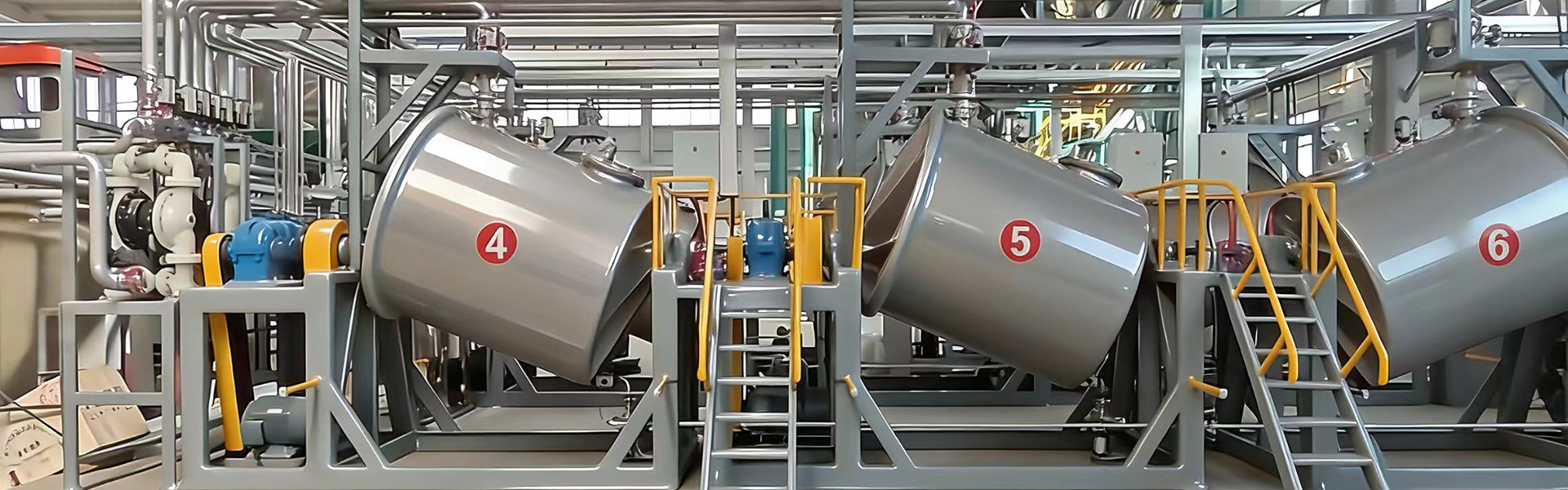
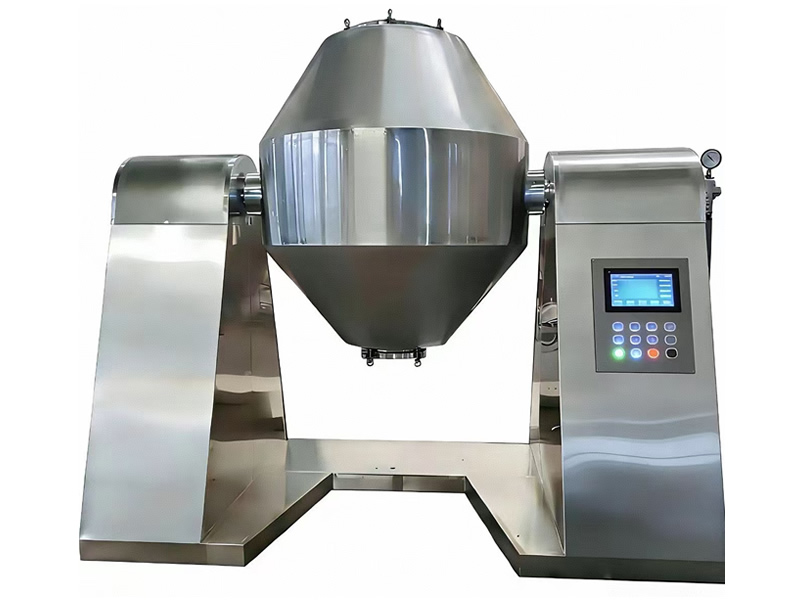
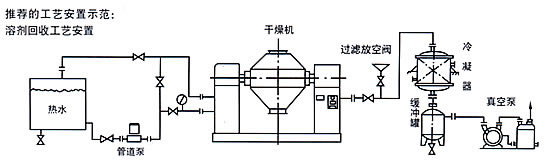
The rotary vacuum dryer introduces heat energy (such as hot water, low-pressure steam or heat transfer oil) into a sealed interlayer, and the heat is transferred to the material to be dried through the inner wall. Driven by power, the tank rotates slowly, and the materials inside the tank are constantly mixed, thereby achieving the purpose of enhanced drying. The material is in a vacuum state. The decrease in vapor pressure causes the moisture (solvent) on the surface of the material to reach a certain state and evaporate, which is promptly discharged and recovered by the vacuum pump. The moisture (solvent) inside the material constantly penetrates to the surface and is discharged. These three processes occur continuously, and the material achieves the drying purpose in a very short time.
Technical specification
| Name | unit | 100 | 350 | 500 | 750 | 1000 | 1500 | 2000 | 3000 | 4500 |
|---|---|---|---|---|---|---|---|---|---|---|
| Total volume | L | 100 | 350 | 500 | 750 | 1000 | 1500 | 2000 | 3000 | 4500 |
| Swept volume | L | 50 | 175 | 250 | 375 | 500 | 750 | 1000 | 1500 | 2250 |
| Heating area | m² | 1.16 | 2 | 2.63 | 3.5 | 4.61 | 5.58 | 7.5 | 9.6 | 23.8 |
| Repost speed | rpm | 6 | 6 | 6 | 6 | 6 | 6 | 6 | 4 | 4 |
| Power efficiency | kw | 1.1 | 2.2 | 4 | 5.5 | 7.5 | 7.5 | 11 | 15 | 22 |
| Rotation height | mm | 1600 | 1930 | 2060 | 2160 | 2260 | 2760 | 3160 | 3500 | 4150 |
| Design pressure inside the tank | Mpa | -0.09~-0.096 | ||||||||
| Mezzanine design pressure | Mpa | 0.3 | ||||||||

